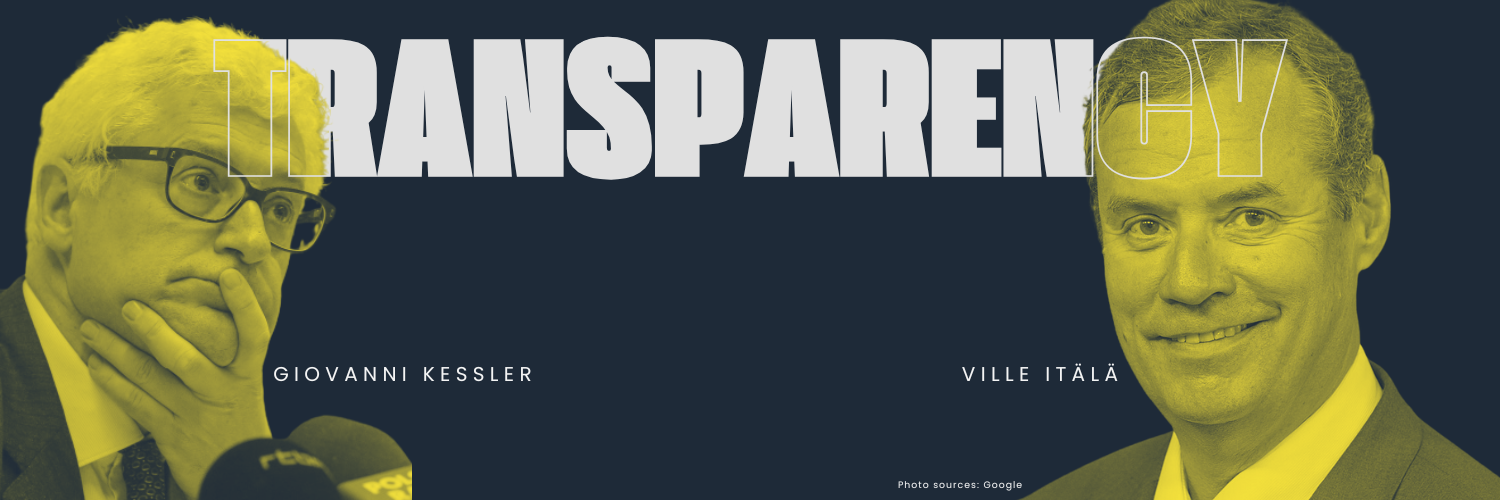
OLAF’s annual report was the public’s instrument panel: how many alerts (“incoming information”) came in, where they came from, and what OLAF did about them. Under Giovanni Kessler (2011–2017), the report showed country-by-country complaint intake — a rough but essential thermometer of risk and responsiveness. In the 2018 report (Figure 27 – page 57) you can still see “Incoming information from Member States” listed line by line: Belgium (18), Romania (58), Spain (32), Germany (29) and so on.
Under Ville Itälä (2018–2025), the table disappears.
From Kessler’s numbers to Itälä’s curtain
Under Giovanni Kessler, OLAF’s reports may have had their flaws, but they provided one foundational building block for any serious evaluation: the country-by-country “complaints received” metric. Every year, country tables showed precisely how many tips, alerts — “signals” — arrived at OLAF’s door regarding each Member State.
However imperfect, this let the public track activity versus action: Did OLAF receive 100 complaints from Country X, but investigate only one? Did high-funded states see a flood of suspicions, or did powerful capitals keep problems under wraps? The data was imperfect, but actionable, real.
But something happened on the way to the present. As OLAF’s institutional budget increased, as the EU funneled unprecedented sums through new and old Member States, as cross-border corruption scandals grew, the agency began decreasing transparency.
The moment is precise: in the 2019 reporting year — the first full year under Ville Itälä, this vital table vanishes from OLAF’s public record. What remains is surface narrative — colorful “success stories”, broad regional statistics, and only aggregate metrics. The public can no longer see what OLAF receives, only what it concludes.
Why was this deliberate opacity imposed at the heart of European anti-fraud strategy? Was it a managerial calculation, a political accommodation, or simply a bid to shape the EU’s public image? Was it fatigue with criticism? Institutional vulnerability to political pressure? Only OLAF’s directors — past and present — know the answer, and European citizens deserve it in public.
Why this matters
Without intake by country, the signal-to-action ratio disappears. You can no longer test basic integrity questions: Did Country X generate 200 alerts with 2 investigations? Or 20 alerts with 10 investigations? Low “concluded cases” could reflect low fraud — or low follow-up. The public can’t know.
Meanwhile, OLAF still publishes concluded cases by country — tables you can check year by year. But outputs without inputs are performance without a baseline.
Belgium remains as a warning signal. In a decade where it handled over €31 billion in direct EU funds and €7.87 billion for NGOs and nonprofits, in the EU’s administrative heart — ⚠︎ OLAF concluded just four (4) fraud cases in 10 years. Fewer than in Congo (7) or Uganda (6).
Did Belgium truly receive only four credible complaints in ten years, or were hundreds of signals filtered? How?
This fact begs for context you cannot audit because the intake per country is no longer reported. In the absence of intake data, the truth is unknowable and systemic corruption risks are camouflaged.
The removal of intake statistics, the most basic thermometer of fraud risk and systemic health, disables any meaningful check on OLAF’s selectivity or potential capture by political interests.
Questions that deserve answers:
In 2018, OLAF reported intake by country; in 2019, that data vanished — making Itälä’s first full year the precise breakpoint for transparency.
To acting Director-General Salla Saastamoinen: Will OLAF restore the Member-State intake table in the next report? If not, what legal or policy basis justifies keeping the public from seeing the number of complaints per country, a number so central to public oversight?
To Ville Itälä: You took over in 2018; 2018 still reports intake by country, 2019 no longer does. Who decided to remove it, and why? Did OLAF assess the impact on public oversight before pulling the most basic fraud-risk signal from the report?
To Giovanni Kessler: Did you ever face institutional or political pressure to curtail real reporting? Would you defend OLAF’s new opacity if you were still in charge?
To Every MEP and Budget Committee: Is it tolerable for the EU’s anti-fraud command center to publish less information now than it did 10 or 20 years ago, when budgets were smaller and risks were fewer?
The EPPO standard and the cost of silence
Contrast this with the European Public Prosecutor’s Office. In both 2023 and 2024, EPPO’s annual reports publish per-country “reports received” and “investigations opened.” You can actually see where the attrition happens, country by country. It’s not perfect — rejection reasons remain opaque — but the public baseline exists.
EPPO’s numbers may be brutal, take Italy as an example. For context, in 2023 Italy had 625 reports and 556 opened investigations (very high conversion, ≈89%). In 2024, the open rate decreased, EPPO shows 698 reports/complaints received and 458 investigations opened — an ≈66% open rate.
Public trust demands this exposure. OLAF’s silence — by comparison — all but guarantees that problems can be swept under institutional carpets, with taxpayers left none the wiser.
The public-interest test
OLAF’s mission is to protect EU funds, not the EU’s image. Inputs + outputs is the minimum for democratic oversight. Keep the concluded-cases table — yes. But put back the intake by country.
Without it citizens cannot see whether low case numbers mean low fraud or low follow-up; journalists cannot detect systemic under-reporting or institutional capture behind “good-news” outputs; auditors and parliaments lose a comparator against funding flows and complaint volume.
This is not about embarrassing Member States. It is about verifiable baselines — the difference between a watchdog and a political tool.
OLAF’s own statistical record is the proof: in twenty years, the move has been from transparency, to curation, and then to omission. Europe’s anti-fraud watchdog has retreated from the sunlight of scrutiny.
Which Member State will ask for this metric first? Which journalist will demand its return?
This is where Europe’s anti-fraud story stands: not at the summit of accountability, but at a crossroads where less is shown, and more is at stake than ever.
All numbers, statements, and timelines are based on a complete cross-audit of OLAF’s official annual reports from 2004–2023. Verification can be found in the cited documents: